Ready to take the opportunity
Good fortune doesn’t come close to describing the lucky break James Clarke had when he was starting his first business. But as the actor Denzel Washington once said, “luck is when an opportunity comes along and you’re prepared to take it.”
In the late nineties, aged twenty-three, Clarke set up a component distribution and design company with a colleague after working for a business representing overseas manufacturers in the UK which, he says, got greedy and went bust.
“We got together with a guy who had sold his company to them but had received nothing after his first staged payment. He had the premises and staff, and I had suppliers who were backing me.”
But by any measure, that wasn’t his only good fortune. “The receivers of the company which had employed me phoned me to say they had £200,000 of stock and would I be interested because it had to be out of the premises where they were being stored in less than a week’s time. I wanted to see what they were offering in person, but they insisted if I wanted to make an offer, I had to do it right now. So, I said okay, £1000. And they agreed!”
His largest customer for nine years was Jabra, the telephone headset makers, which eventually turned out to be prophetic.
“We were providing them with a lot of kitted components for their wireless headsets, so we learned a lot about that kind of product,” Clarke explains. Then in 2003 Clarke sold the business, but a year before he’d set up a finished products division, which wasn’t part of the sale of his company.
Just as well. Because what happened straight after the new owners took over was that Clarke and his co-directors were told to leave the building. Or rather his building as Clarke had purchased it sometime before.
Not surprisingly, he recalls the moment somewhat vividly. “It was on November 1st and I had assembled the staff to introduce the new owners, who then turned to us and said ‘gentlemen, you’re dismissed’.
“And we suddenly realised it wasn’t a joke about us no longer owning the company. The next thing I remember is the three of us standing in the car park looking at each other, each clutching a cardboard box of possessions.
“My two partners were retiring anyway but I was out of a job, locked out from doing anything which would be considered to be competing with the new owners, and I had been ejected from my own building. I couldn’t say my goodbyes to the staff which was really quite hurtful. “If the new owners had bought an ailing company and needed to get rid of management straight away, I could understand, to a degree, but that wasn’t the case. We were profitable and nothing was really broken.”
So, he decided to turn his erstwhile finished products division into a business, with the new venture focusing on telecom headsets as there were only three significant providers in the country.
Actually, it wasn’t his first entrepreneurial side hustle. On a business trip to the United States, he had seen a company selling affordable ultrasonic cleaners made in China which he thought would do well back home.
His partners weren’t terribly interested so he set up a separate company which his wife ran from home to sell the range in the UK on an exclusive basis. “She came up with the name, JPL - James Products Limited - and I used that existing company for my new venture,” he explains.
In the UK, the telecoms headset market was dominated by Jabra, Plantonic, and Logitec, and rather than compete head on as it were, Clarke went to resellers who would have their name on the product JPL provided. “My logic was that white label would mean they would get behind it more and do the marketing so we could focus on designing and developing more products with our sub-contract manufacturers,” he explains. “You’ve got to over-achieve if you’re the underdog. I would say before Covid-19, 70% of our sales in the UK carried the resellers’ brands.”
“A share of the UK telecom headset market (they now have about 25%) would have enabled us to have a nice enough living,” says Clarke, but in 2017 he got a call from a US distributor who had dealt with a major product recall for one of the major manufacturers -and received little thanks and no compensation for their efforts.
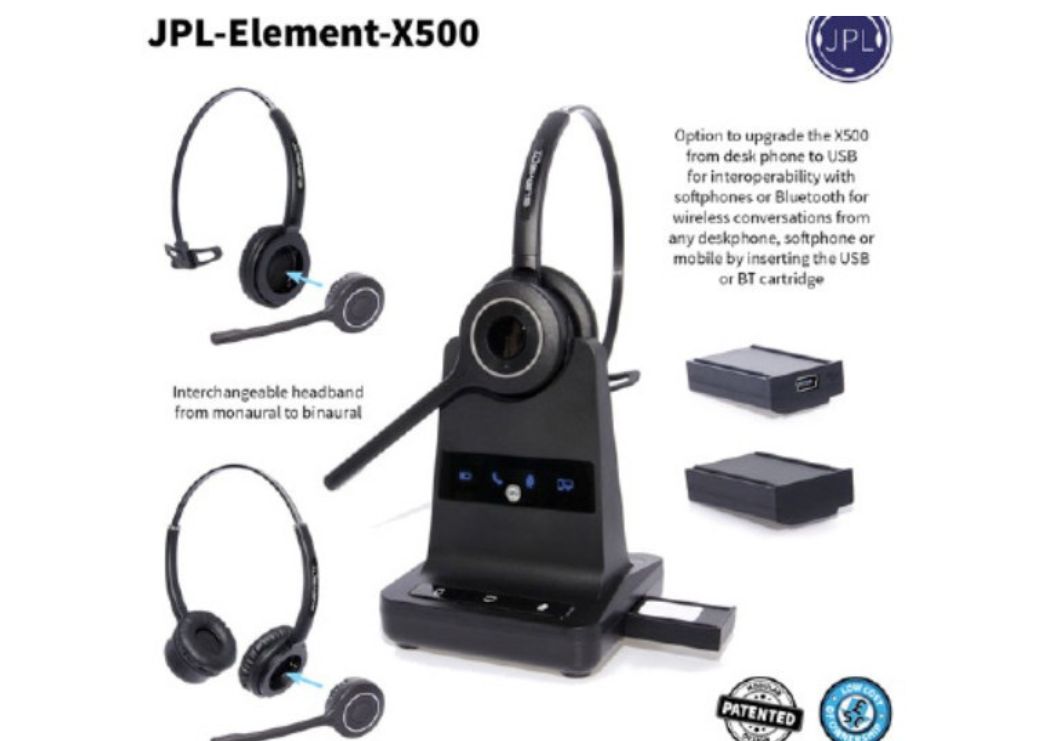
“We had designed a headset which enables the headband and microphone to be taken apart, and patented the concept, and the innovation had caught their attention,” says Clarke. “It meant a call centre operation didn’t need to buy a complete headset for a new employee - they just clipped on a replacement microphone.
“The idea came about because we were looking at returns and broken headbands were the main reason, which meant providing a complete replacement. So, we were introducing something completely different from what was available.
“With the new product there have been zero returns in two-and-a-half years. And because people would often stretch the headband when they take their headset on and off, and eventually it can crack, we also designed a cap to go on each end of the headband to take the strain. “The distributor wanted exclusivity and as the biggest telecom headset reseller globally, they gave us a foothold in the US.
“We locked in with them because with our patent there was no race to the bottom with a resulting loss in margin because competitors weren’t able to pile in.”
Eventually though Clarke had to face up to making an incredibly difficult decision. “The US distributor was also a reseller, and the exclusivity agreement effectively covered both roles, which we realised wouldn’t enable us to grow as much as we wanted to or provide us with any safety net.
“I was true and honest with them. I explained that it wouldn’t be in anyone’s interests if we were totally reliant on them for our sales in the USA, and this was now the point where I could afford to un-couple if they kicked us out. They didn’t.
“We only have one person in the USA because we signed up with third parties in that country who are good at stock holding and fulfilment. One location in the USA is not enough so why not utilise those who are expert at it because that means we have no need to replicate that resource.
“Because of the internet we can get a dispatch note to a warehouse in the USA as quickly as to the building next door to us, so we realised we can do all the administration from our UK premises. The same arrangement is in place for our operations in the Netherlands and Russia.”
The sudden shift to homeworking didn’t do JPL any harm at all, but it wasn’t a time of basking in the order intake either. “The problem was that the lockdown resulted in our warehouse emptying overnight,” says Clarke. “We couldn’t just double production because that would have needed additional tooling and even if that had been something we could have fast tracked, it still would have taken months to put in place.
“And we didn’t know whether the sudden increase in demand because of unforeseen circumstances had been a flash in the pan, which would have meant we had invested hundreds of thousands of pounds to increase capacity unnecessarily.”
The conundrum was addressed by the three factories in the Far East, with their 280 staff, increasing the number of shifts. “They are all independently owned business and so are we, and we haven’t changed any of them for more than twelve years,” Clarke explains. “Their prices are reasonable, we enjoy the mutually beneficial relationship with experts in our field, and we’re the right size for each other.”
With what stock they could muster, JPL decided to supply only existing customers and a couple of key prospects who had come to them after being approached pre-pandemic.
“As a result of showing loyalty, we haven’t lost an existing customer since,” Clarke reveals. “For us it wasn’t about selling product - people were buying - so it all came down to how much we could get through the supply chain.”
Covid-19 gave JPL an opportunity to pivot rather than it being a necessity. Because call centre staff were working from home because of the lockdown, they would use their headphones to listen to music as well as take calls, so JPL developed what they call audio technology. With the addition of a chip, the headset can be switched from mono or pseudo-stereo for calls to true stereo for audio.
“Our usual way to launch a product is to share the concept and the intended price point with resellers,” says Clarke. “If they have been involved from the outset, it means they’ve been on the journey with us and they’re more likely to get behind it. Competitors will produce a product and then present it to the resellers. Of course we get them to sign NDAs. We’ve never had to enforce them, but they give it some gravitas and people tend to feel honoured to be asked to sign one.”
But not everything turns out as expected. It was back in 2000 that Clarke saw an electric scooter at a factory he was visiting in the Far East and arranged for samples to be sent over there and then. He knew when they had been delivered because he saw his staff whizzing around the car park on them. He got an appointment with a major multiple retailers, their buyer had a go on one and Clarke knew from his reaction that they would place an order.
“We brought in a couple of containers for five of their stores to start with and the scooters flew out the door,” he recalls.
“I remember someone in our sales office coming over to tell me that the total number taken by that one customer had passed half-a-million - and still the orders were coming in. We went from excitement to the cold fear of trying to work out how we were going to deal with the volume.
We’d sent out staff to China to do a final quality check on each scooter but by now they had no time to inspect them individually.
“Then we came back from the Christmas break in January 2002 to receive emails from one store after another about customers returning their scooters because they didn’t work - so many that by midday we were called up to their HQ and were told there was up to a 22% failure rate. They owed us £6million at that time - and three of us had given personal liabilities for the funding. Their CEO said we could sue them for it, but we’d go bust in the meantime.
I couldn’t think straight; we needed a fifteen-minute break because it felt like my brain had stopped working. For the first five-minutes, none of us said anything. Then we went back in and we agreed the scooters would be brought to a central location and we would repair them.
“The problem was caused when the delivery companies were unloading the product. They dropped the cartons off the lorry and while the scooter itself, which had passed an impact test, was completely unscathed, the lead acid battery and cables shifted apart.
“If we had been allowed to follow the original specification and hard-wired battery and cables together, the problem wouldn’t have happened, but the customer insisted that purchasers would want the option of replacing the battery.
“We’d fix them up, the retailer would make staged payments, and by April they actually placed another order. But my partners didn’t want anything more to do with electric scooters so I had to put it at the bottom of the desk drawer because I knew if I told the customer we weren’t going to supply any more, they wouldn’t have completed the last £1million staged payment.”
Not surprisingly, the experience meant Clarke abandoned his plans to diversify into electric bikes.
Today diversification at JPL is about webcams and conferencing products. “We have been able to muscle in by making our product universal rather than the end-user having to download different software, and we increased the viewing angle so that someone two metres away can still be in shot,” explains Clarke. “And for the first time our headset products, housed in a protective case, are now in retail outlets - Costco in the USA, Currys in the UK.”
He has a particular mantra as a business owner.
“If you can achieve something without having to bring in additional shareholders it means you run the business with fewer complications,” he suggests. “It also means you can concentrate on organic growth. I had a lucky start with my first company so we didn’t need equity investment, and we could concentrate on building our kind of business rather than having to wrangle with outside shareholders. “My first silly goal with JPL was to get past the turnover of the company I sold, and I get a kick out of designing products that people want because they fill a gap in the market.”
Clarke’s twenty-four-year-old year son joined JPL straight after school. “The intention,” he says, “is for me to be here two or three days a week fiddling around with the design work and if there are rules in place for finance, simple parameters so I can see how the company is performing, why would I want to sell it?
But that means the business has to make more of a return than if I sold it, because future sales revenue is more of an unknown than a purchase price.”
“I also decided that If any of my kids came into the business, they would have a share commensurate with the work they were doing,” he explains. “If they aren’t involved, they have no say whether the business is ever sold and would only get 10% each of its value. I don’t want anyone not active in the business to have a voice in its future.
“If you want your company to run better without having day-to-day operational involvement, you need to be able to recognise what your biggest gift to the company is and bring in better people to do the rest. I decided to appoint a PA to better organise my time. They’re responsible for getting the data from our country managers for example which saves me from doing the chasing. That was never my favourite task!”
www.jpltele.com